ALG’s Aparna Sreedhar Delivers A Guest Lecture At Annapurna College Of Film And Media, Hyderabad

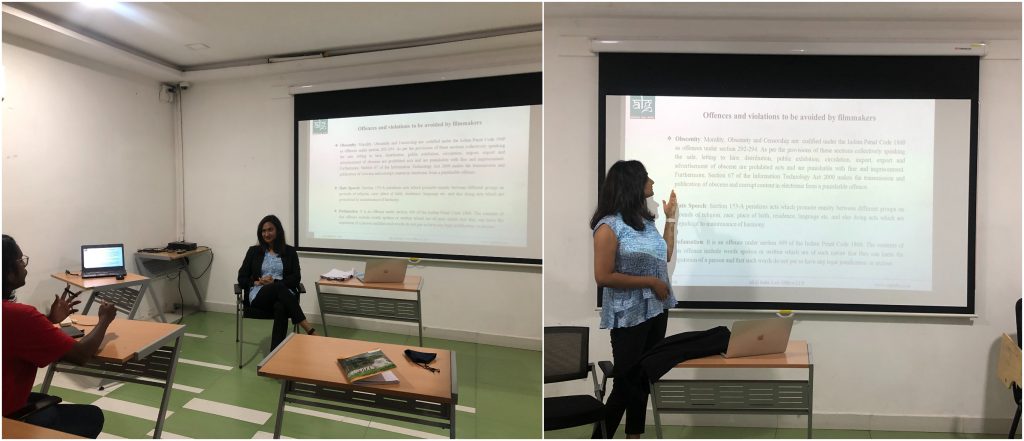
ALG’s Aparna Sreedhar recently visited Annapurna College of Film and Media, Hyderabad for an interactive guest lecture on “IP & Film Industry”. She covered various aspects of copyright and trademark law related to the film industry. Students of the Final Year of the Masters course in Film Production attended the lecture and discussed questions like ‘what happens if a film title has already been used by a earlier film but the script is different?’; ‘ how does one protect a concept note?’; ‘would one still get royalty if music rights have been assigned?’, etc. She also provided practical insights and Do’s and Don’ts for the budding film makers.

Special Legal Issues Seminar-General IP (SLIS-GIP) On “Are The Terms ‘Party’ And ‘Witness’ Interchangeable In Respect Of Order XIII Rule 1(3)(a) Of The Code Of Civil Procedure, 1908?”

A ‘Special Legal Issues Seminar-General IP’ (SLIS-GIP) was conducted by Janaki Arun, Senior Associate, on “Are the Terms ‘Party’ and ‘Witness’ Interchangeable in respect of Order XIII Rule 1(3)(a) of The Code of Civil Procedure, 1908?”. The seminar revolved around a recent decision of a Division Bench of the Bombay High Court in Mohammed Abdul Wahid v. Smt. Nilofer and Ors., [Writ Petition Nos. 6931 and 7717 of 2019] which elaborately dealt with this question. The seminar also delved into the statutory provisions applicable to parties to a suit and witnesses under the Code of Civil Procedure, 1908 and the Indian Evidence Act, 1872. The session concluded with some interesting questions and discussion among the team, including why it is necessary to distinguish between a party to a suit appearing as a witness and the witness of a party to a suit.

The presentation can be accessed here.
Practice Work Shop (PWS) On ‘Does Documenting Traditional Knowledge Aid Preservation Or Lead To Dissemination?’

During last week’s Practice Work Shop (PWS) Session, Sanjukta Kaushik, Trainee Associate, lead a discussion on whether documenting traditional knowledge aids its preservation or lead to its dissemination. The session witnessed an engrossing discussion on the growing interest in documenting traditional knowledge, the advantages and disadvantages that it brings to the communities involved, and factors such as language of initial documentation that should be considered in the process.

Legal Issues Seminar-General IP (LIS-GIP) On “Are Motion Trade Marks Protected?”

A ‘Legal Issues Seminar-General IP’ (LIS-GIP) was conducted by Hardik Choudhary, Associate, on “Are Motion Trade Marks Protected?”. The seminar delved into the evolving protection of unconventional marks, particularly focusing on motion marks. The seminar specifically looked into the statutory provisions relating to graphical representation, the views of the Trade Marks Registry, and discussed the need for clarity on motion marks drawing parallels from other jurisdictions. The session concluded with some interesting questions and discussion among the team, including what approach can be taken to ease the requirement of graphical representation of motion marks.

The presentation can be accessed here.
Special Legal Issues Seminar (SLIS) On “Draft Cinematograph (Amendment) Bill 2021”

A Special Legal Issues Seminar (SLIS) was conducted by Sannidhi Mahapatra, Associate and Dishti Titus, Principal, presenting the firm’s submissions made in response to the Draft Cinematograph (Amendment) Bill 2021 published by the Ministry of Information and Broadcasting in June 2021. The Seminar provided interesting insights on the proposed amendments including additional age-based certifications, revisionary powers conferred on Central Government, provisions for prohibition of piracy, and ALG’s comments and recommendations (accessible here).

The session concluded with interesting questions from the team on the applicability of the guidelines to OTT platforms, the reasons behind further sub-division of age-based certification, and possible implications of the revisionary powers of Central Government.

The presentation can be accessed here.
  • Non Solicitation
  • Data Privacy & Protection
  • Conflict of Interest Policy
  • Data & Document Retention Practice
  • Firm Management Policy
  • Liability
  • Disclaimer
  • Privilege
  • Copyright
  • Billing Policy
  • Pro Bono