Easier and safer access to priority documents – WIPO digital access service

In a public circular dated March 12, 2018, the Office of The Controller General Patents, Designs & Trade Marks has informed that the Indian Patent Office (IPO) has started the WIPO Digital Access Service (DAS) with effect from January 31, 2018.

The WIPO Digital Access Service (DAS) is an electronic system allowing priority documents and similar documents to be securely exchanged between participating intellectual property (IP) offices under the WIPO-India Cooperation Agreement. The system enables applicants and offices to meet the requirements of the Paris Convention for certification in an electronic environment.

Administered by WIPO, the Service is intended for use with documents related to patents, utility models, industrial designs and trademarks. Using a secure access code provided by WIPO DAS, applicants can simply request the Office of first filing to add/deposit the priority document into the WIPO DAS system and request the Office of second filing to obtain access of the document. Thus, while reducing costs to pay for multiple copies of priority documents, the WIPO DAS also ensures secure exchange of documents.

India is the 7th country to publish full search strategies and reports

The Office of The Controller General Patents, Designs & Trade Marks has announced that the Indian Patent Office (IPO) has reinforced its commitment to quality as an International Searching Authority (ISA). It has decided to share full Search Strategies along with the International Search Reports for publication on Patentscope, since 1st January 2018. The IPO is the seventh amongst 22 ISAs under the PCT to start this service.

TM Office issues public notice regarding abandonment of trademark applications

The TM Office has issued a Public Notice on January 22, 2018 listing out applications in which no replies have been received to office actions (which were issued on or before December 31, 2017) and providing time till February 22, 2018 to respond, failing which the applications will be deemed to have been abandoned. The public notice is available at

http://www.ipindia.nic.in/writereaddata/Portal/IPOJournal/1_2578_1/PUBLIC_NOTICE_REGARDING_DEFAULT_IN_FILING_OF_REPLY_IN_RESPECT_OF_OFFICE_OBJECTION_RAISED_IN_EXAMINATION_REPORT_AND_LIST_OF_SUCH_APPLICATIONS_-_NOTICE.pdf

The Patent (Amendment) Rules, 2017 – Enabling Foreign Startups to avail benefits

The Patent (Amendment) Rules, 2017 [which came into effect on December 01, 2017, vide Gazette Notification] have amended the definition of the term “Startup” under the Patents Rules, 2003 to include within its scope the foreign startup companies (viz. startups having registered office outside India). Firstly, the new definition has done away with all details of qualifying criteria for a Startup under the previous definition, and has simply added a qualifier for Startup to mean “an entity in India recognized as a startup by the competent authority under Startup India initiative”. Secondly, in respect of foreign entities, the definition includes those entities which fulfill the “criteria for turnover and period of incorporation/registration as per Startup India Initiative and submitting declaration to that effect.”

Accordingly, for Indian Entities to avail startup benefits under the Patent regime, they need to get themselves enrolled under the Startup India Initiative, for which the following criteria needs to be fulfilled:

(a) The entity should be incorporated as a private limited company or registered as a partnership firm or a limited liability partnership;

(b) The entity should be incorporated or registered not prior to seven years; however, for biotechnology startups, not prior to ten years;

(c) The entity’s turnover for any of the financial years since incorporation/ registration should not have exceeded INR 25 crores (approx. USD 4 million);

(d) The entity should not have been formed by splitting up or reconstruction of a business that was already in existence; and

(e) The entity should work towards innovation, development or improvement of products or processes or services, or should be a scalable business model with a high potential of employment generation or wealth creation.

For Foreign Entities, however, the criteria that needs to be fulfilled (and established) are:

(a) The entity should be incorporated or registered not prior to seven years; however, for biotechnology startups, not prior to ten years; and

(b) The entity’s turnover for any of the financial years since incorporation/ registration should not have exceeded INR 25 crores (approx. USD 4 million).

A foreign company will need to provide a declaration to the effect that these criteria are fulfilled in order to avail benefits.

Pursuant to this amendment, any foreign company qualifying as a “Startup” is entitled to avail benefits provided under the patent regime in India, which includes rebate of upto 80% on official charges payable at the Patent Office.
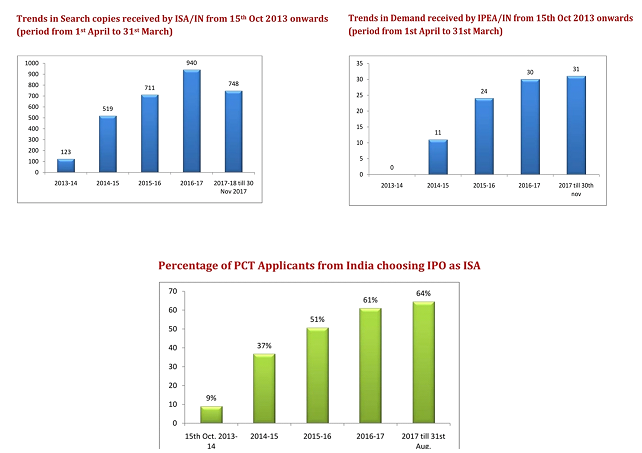
Indian Patent Office’s (IPO) growing popularity as International Search Authority (ISA)/ International Preliminary Examining Authority (IPEA)

The Controller General of Patents, Designs and Trademarks (CGPDTM) has published data this week on discernable trends of the number of PCT Applicants opting for the IPO as ISA and/or IPEA since 2013.

The number of search copies received by the ISA/IN per fiscal year has seen an increase from 123 (FY 2013-14) to 940 (FY 2016-17). Likewise the number of demands received by IPEA/IN per fiscal year has seen an increase from 11 (FY 2014-15) to 30 (FY 2016-17).

The data available reflects a seven-fold increase in the number of PCT applicants from India choosing IPO as ISA from FY 2013-14 to FY 2017-18.

The IPO’s popularity as ISA/IPEA may be attributable to two reasons – the relatively lower official charges of the IPO; and the applicant becoming eligible for expedited examination of the corresponding national application for patent in India. The IPO has reportedly received 181 requests for expedited examination till October 31 through ISA/ IPEA route.

(Image from:- http://www.ipindia.nic.in/)

  • Non Solicitation
  • Data Privacy & Protection
  • Conflict of Interest Policy
  • Data & Document Retention Practice
  • Firm Management Policy
  • Liability
  • Disclaimer
  • Privilege
  • Copyright
  • Billing Policy
  • Pro Bono