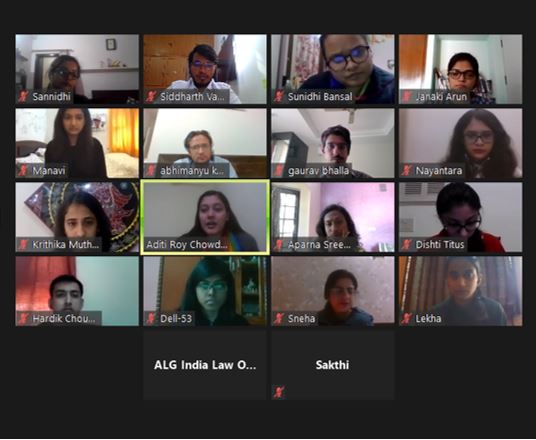
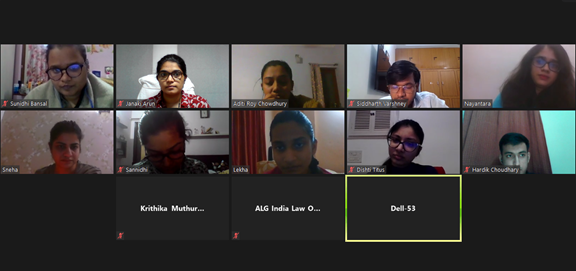
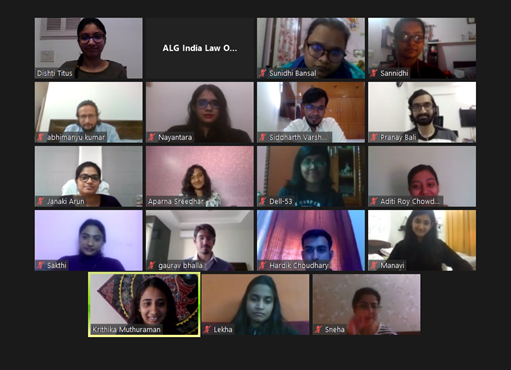
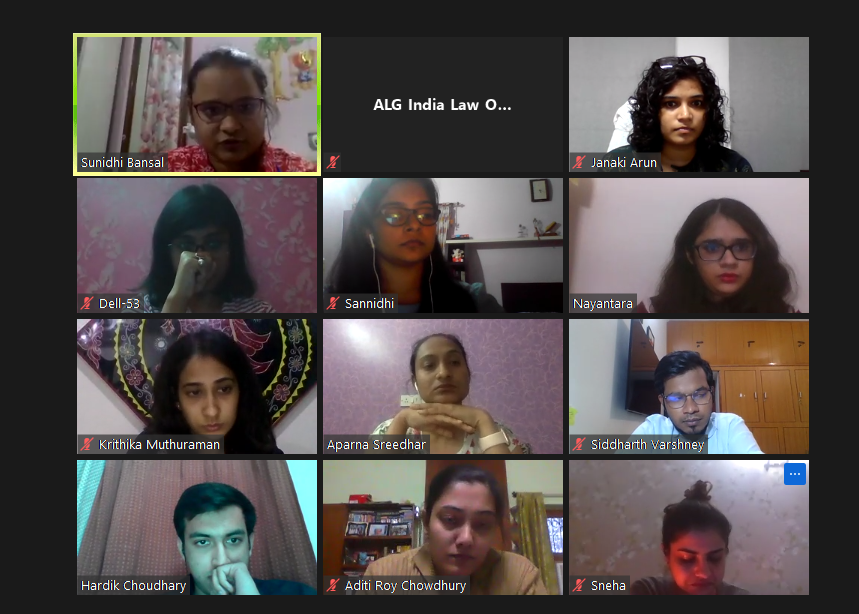
As a part of ALG’s Practice Workshop Series, Sneha Tandon, Associate, lead a discussion on ‘Bringing IP closer to the classrooms’. The discussion saw the associates engaging in a debate on whether IP should form a part of the curriculum for high school students and the extent of dissemination of IP knowledge required in the country.
A ‘Legal Issues Seminar’ was conducted by Dishti Titus, Senior Associate, on The Code of Criminal Procedure, 1973 (Cr.P.C.) in the context of IP Offences. The seminar provided an introduction to the Cr.P.C. and its applicability to Offences under various IP statutes. First in a 10-session module, the seminar also elaborated on the classification of various offences laid out in the respective IP statutes, and the implications thereunder.
The session saw some interesting questions from the team on summary suits in respect of trademark related offences and the procedure and requirements for conversion of summons cases to warrants cases.
As a part of ALG’s Practice Workshop Series, Sunidhi Bansal, Associate, lead a discussion on ‘India and South Africa’s proposal on the waiver from certain provisions of the TRIPS Agreement for the prevention, containment and treatment of COVID-19’. The session saw the associates raising interesting questions on the monopoly of Intellectual Property versus its exploitation for the greater good in these unprecedented times.
Wanting to delve into stories written by Indian authors, ALG’s Book Club met in November to virtually discuss “The Collector’s Wife” by Mitra Phukan. Set in a small town in Assam with the backdrop of insurgency and civil unrest, the book follows the story of the main character, Rukmini, who is married to the District Collector. The story provides an insight into the lives lead by civil servants and their families which struck a familiar chord with many in the book club.
A ‘Legal Issues Seminar’ was conducted by Pranay Bali, Senior Associate, on Evidentiary Issues in Selected IP Court-Judgements, with a specific focus on the Burden of Proof in IP Cases. Part of a 10-session module, the seminar touched upon the concept of Burden of Proof under The Indian Evidence Act, 1872 and The Patents Act, 1970, and its applicability in suits for infringement, opposition proceedings and rectification proceedings under the Trade Marks Act, 1999.
The session concluded with interesting questions from the team on applicability of certain principles of the Indian Evidence Act, 1872 to the Affidavits furnished in trademark opposition proceedings, and the burden of proof in suits for infringement of patents, where the defence of a different process (from the patented process) is sought. The presentation can be accessed here.
The contents of this website are meant solely for the purposes of
information and updates, and not for the purposes of advertising or
soliciting. ALG India Law Offices LLP is not responsible for decision(s)
taken by anyone on the basis of information/updates provided in
the website.
By clicking "ENTER" below, you acknowledge that the information/
updates provided on the website does not amount to advertising
or solicitation.